
Coconut oil solidifies in salad dressing because regular coconut oil starts to firm up around 76°F (24°C) and below. That’s obviously much warmer than a refrigerator. If your jar of coconut oil, lime, and ginger salad dressing develops white flecks or a waxy layer after chilling, that is often just the coconut fat changing from liquid to solid.
Fortunately, you usually don’t need to throw the dressing away. The quickest fix is to gently warm the closed container in lukewarm water until the oil liquefies, then whisk or shake it again. For a dressing that stays easier to pour straight from the fridge, change the oil rather than trying to keep ordinary coconut oil liquid.
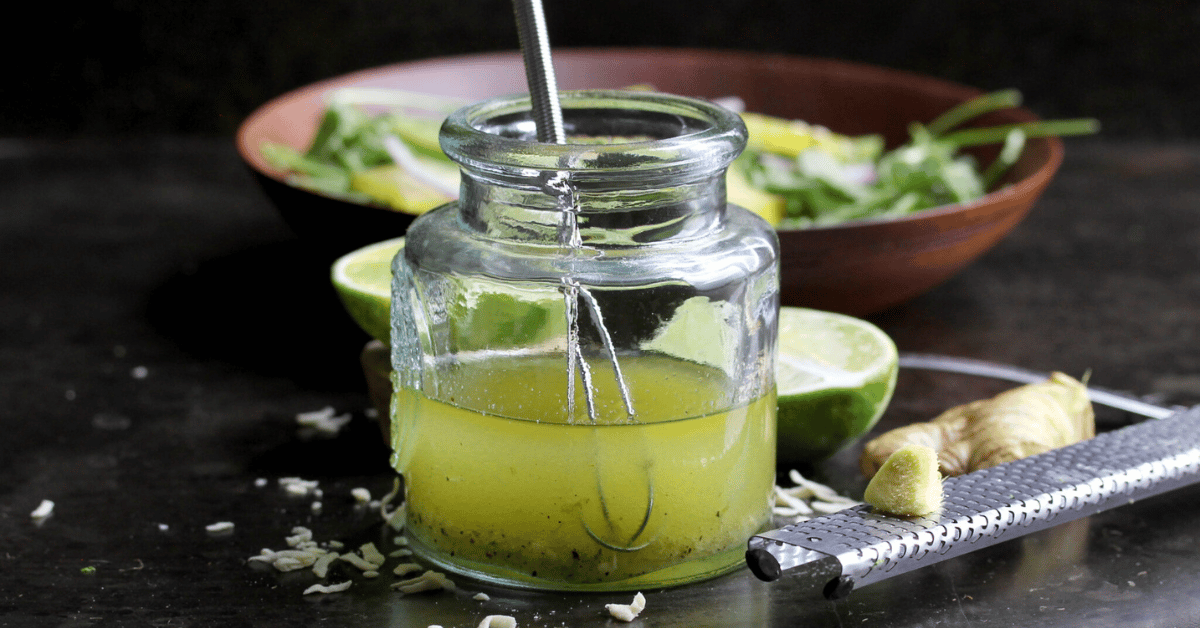
How to fix coconut oil that has hardened in dressing
First, make sure you’re dealing with solidified oil, not spoiled dressing. Coconut oil usually makes smooth, pale or white patches, beads, or a firm cap when cold. If a refrigerated dressing still smells and looks normal apart from those changes, try this:
- Keep the lid closed. Use a leakproof jar or bottle that can sit upright in a bowl without letting water in.
- Set it in lukewarm water. Use comfortably warm tap water, not boiling water. Keep the water below the lid, especially if the seal is imperfect.
- Give it a few minutes. Swirl the container gently and replace the water if it cools. The time depends on how much dressing you have and how solid the oil is.
- Shake or whisk again. Once the white fat has melted, recombine the oil with the citrus juice, vinegar, spices, or other ingredients.
- Use what you need. Return the rest to the refrigerator promptly. The coconut oil will firm up again as it chills.
A wide-mouth jar is especially useful because you can stir with a spoon if some coconut oil remains stuck to the sides. Do not pour boiling water into a cold glass jar or microwave a sealed container. Sudden temperature changes can damage glass, and microwaving can heat a small portion unevenly.
Important: Warming changes the dressing’s texture; it does not make improperly stored food safe. If the dressing has been left unrefrigerated longer than is safe for its ingredients, discard it rather than trying to rescue it.
Why it happens even when the dressing is mixed well
Most common cooking oils are liquid at ordinary room temperature. Regular coconut oil is different: much of its fat crystallizes as the temperature falls. A refrigerator is typically 40°F or colder, so an oil that was completely clear when you mixed the dressing can become opaque and firm during storage.
This is solidification, not the same thing as separation. An oil-and-vinegar dressing may separate into layers because the ingredients don’t stay mixed. Coconut oil can also turn solid within those layers. You can temporarily reunite the ingredients by whisking, but whisking cannot change coconut oil’s melting behavior.
That is why a generous spoonful of Dijon mustard or a vigorous shake may make a vinaigrette look creamy at first, yet leave little fat beads or a thick layer after refrigeration. An emulsifier can help the oil and water-based ingredients stay dispersed; it cannot guarantee that the coconut fat stays liquid when cold.
Four ways to prevent a solid or waxy dressing
1. Use a liquid oil as the main dressing oil
For a vinaigrette you want to pour straight from the fridge, start with an oil such as olive, avocado, or sunflower rather than regular coconut oil. These oils are generally more convenient for chilled dressings, though some olive oils can also become cloudy or partly solid when cold.
If you love coconut flavor, use only a small portion of coconut oil in a larger blend of liquid oil and expect that a little of it might still firm up. There is no guaranteed ratio that keeps ordinary coconut oil completely liquid in the refrigerator.
2. Choose a food-grade liquid coconut oil
Some manufacturers sell coconut oil processed to remove much of the fat that becomes solid at room temperature. For example, Nutiva’s culinary liquid coconut oil is marketed for drizzling on salads and remaining pourable.
Check the actual bottle rather than assuming that every product called “fractionated coconut oil,” “MCT oil,” or “liquid coconut oil” belongs in food. Some products are sold only for cosmetic use. Use an edible oil clearly labeled for cooking or consumption, and follow its storage and use directions. Liquid coconut oil can also have a milder flavor than virgin coconut oil.
3. Combine ingredients at a similar temperature when serving immediately
If you’re making dressing for a meal right now, bring the other ingredients to a comfortable room temperature and melt the coconut oil gently before whisking everything together. Pouring melted coconut oil straight into very cold citrus juice or vinegar can make it form tiny solid flecks on contact.
This solves an immediate mixing problem, not a storage problem. Even a perfectly smooth dressing will harden again when you refrigerate it.
4. Make a small batch just before serving
Want the coconut aroma of virgin oil and don’t want to switch ingredients? Make only as much as you’ll use at that meal. Whisk melted coconut oil with the rest of your dressing ingredients just before serving, and toss it with the salad right away. If the greens or other ingredients are refrigerator-cold, you may still notice some thickening.
For meal prep, a dressing based on an oil that stays fluid in the cold will be much less fussy.
What if your salad dressing has white bits, a thick layer, or two separate layers?
| What you see | Likely explanation | What to do |
|---|---|---|
| White or off-white waxy pieces | Coconut fat has solidified. | Warm gently in lukewarm water, then mix again. |
| A firm, pale layer at the top | Fat has separated and chilled into a solid layer. | Let the fat melt, then whisk or shake to combine. |
| Clear oil above a watery layer | The vinaigrette has separated. | Shake or whisk; add a little mustard if it fits the recipe. |
| Cloudy oil that still pours | Some oils naturally become cloudy when cold. | Let it warm briefly and check whether it clears. |
| Fuzzy growth, unusual bubbling, or an off smell | Possible spoilage or contamination. | Discard the dressing. Do not taste it to decide. |
If the mixture has a strange smell, visible mold, or has been held at unsafe temperatures, don’t assume solidified coconut oil is the only change. You cannot confirm food safety by watching white bits melt.
How to store a coconut oil salad dressing safely
Store homemade dressings containing fresh juice, garlic, ginger, herbs, dairy, or other perishable ingredients in the refrigerator. Keep the jar covered, use clean utensils, and follow the storage directions for the particular recipe. Our lime-and-ginger version calls for refrigeration and use within three days.
For dressing with fresh garlic or herbs, room-temperature storage is especially important to avoid. Oil does not automatically preserve those ingredients, and low-acid foods held in oil can create food-safety hazards. A splash of vinegar or citrus does not make an improvised garlic-in-oil mixture shelf-stable.
If you need to soften the dressing before serving, warm only as long as needed and refrigerate any unused portion promptly. Follow the usual two-hour limit for perishable food out of refrigeration, or one hour when the surrounding temperature is above 90°F. Avoid repeatedly leaving a large jar on the counter for long stretches.
Pure coconut oil may be sold for pantry storage, but that doesn’t mean a homemade dressing containing water-based, fresh ingredients is safe to keep in the pantry. The ingredients in the finished dressing determine its storage needs.
Common questions
Can I stop coconut oil from solidifying by adding mustard?
No. Mustard can help oil and vinegar mix into a more uniform dressing, but it does not permanently lower the temperature at which ordinary coconut fat turns solid. You may still get a thick or waxy texture in the refrigerator.
Will adding more olive oil keep coconut oil liquid?
Replacing some coconut oil with olive oil can make a dressing easier to pour, but any remaining coconut fat may still make small solid flecks when chilled. For the most reliable cold texture, leave out regular coconut oil or use a culinary coconut oil specifically made to remain liquid.
Why is my dressing solid after only a few minutes in the fridge?
Coconut oil begins to firm at a much warmer temperature than the refrigerator. Small droplets of oil can cool quickly, especially when mixed with ingredients straight from the fridge. This doesn’t necessarily mean anything went wrong with your recipe.
Does refrigerating olive oil make it cloudy, too?
It can. Olive oil sometimes clouds or partially solidifies when chilled because of its natural components. The degree varies, and cloudiness by itself doesn’t show that olive oil is spoiled or prove anything about its purity.
Can I microwave hardened coconut oil dressing?
A lukewarm-water bath is easier to control. If you choose to microwave a dressing, transfer a small portion to a microwave-safe, open container and heat cautiously in very short intervals, stirring between them. Never microwave a closed jar, and avoid overheating acidic or fresh ingredients. You shouldn’t have to get the dressing hot to melt coconut oil.
Is it okay if the oil turns solid again overnight?
Yes. The same physical change can happen each time ordinary coconut oil chills and warms. Provided the dressing was handled and refrigerated safely and is still within its usable storage time, repeated solidification alone is not a reason to discard it.
The bottom line
If coconut oil turns your refrigerated dressing into a thick, cloudy, or partly solid mixture, the most likely cause is temperature—not a failed recipe. Warm it gently and mix again for today’s salad. For future batches, choose a food-grade liquid oil that is better suited to cold storage, or make a smaller coconut-oil dressing to use right away. Keep perishable homemade dressings refrigerated regardless of which oil you choose.
Links on this page may be affiliate links, for which the site earns a small commission, but the price for you is the same

Leave a Comment