
A firm potato with just a few small sprouts may still be usable if you remove the sprouts and their eyes completely, according to Iowa State University Extension. But a potato that is shriveled, heavily sprouted or green beneath its skin should be discarded. There’s an important disagreement, too: Poison Control takes the more cautious position that green or sprouted potatoes are better thrown away.
The distinction matters before you start peeling and chopping for dinner. A recipe such as our roasted root vegetable salad calls for russet potatoes, but no cooking method can reliably rescue a potato with excessive natural toxins. The decision belongs at the cutting board, not in the oven.
Why do potatoes sprout, and what makes them risky?
A potato is a living tuber. Over time, the dormant eyes begin producing shoots as the potato prepares to grow another plant. Warm storage conditions and age can speed that process. A tiny shoot isn’t the same thing as a rotten potato, but sprouting does change the food-safety calculation.
Potatoes naturally contain glycoalkaloids, especially two compounds called solanine and chaconine. The highest concentrations tend to occur in sprouts, eyes, the peel and damaged or green areas. The interior of an ordinary fresh potato generally contains much less.
The trouble is that you cannot measure a potato’s glycoalkaloid concentration by looking at it. A small sprout, a large sprout and an area of green skin all provide clues, not a laboratory test. That’s why advice varies between experts who permit careful trimming of mildly affected potatoes and those who recommend discarding them.
Which sprouted potatoes can you keep, and which should you toss?
Use the table as a cautious shopping-and-kitchen checklist. The limited-use cases reflect Iowa State University Extension’s guidance; they are not a guarantee of safety. If you prefer the most conservative approach, follow Poison Control’s advice and discard any potato that has sprouted or turned green.
| What you see | Practical decision | Why |
|---|---|---|
| Firm potato, one or two very small sprouts, no green areas | Iowa State says it may be used after completely removing sprouts and eyes; discarding is more cautious. | The sprout and eye contain more glycoalkaloids than the flesh. |
| Firm potato, small patch of green limited to the peel | Iowa State allows generous peeling and removal of all green tissue; discard if unsure. | The green is a warning sign, even though the pigment itself is harmless. |
| Long or numerous sprouts together with shriveling or softness | Discard. | Greater sprouting and deterioration raise concern. |
| Extensive greening or green flesh beneath the skin | Discard. | Trimming the surface does not address deep greening. |
| Mushy, wet, moldy or decaying potato | Discard. | Spoilage is a separate reason not to use it. |
| Firm, sound potato with no sprouts or green areas | Prepare normally. | It has none of these visible warning signs. |
One particularly useful line in Iowa State’s advice: when sprouts reach an inch or more and the potato has shriveled, throw it away. That is a combination of warning signs, not permission to use every firm potato with a large shoot.
How do you remove small potato sprouts properly?
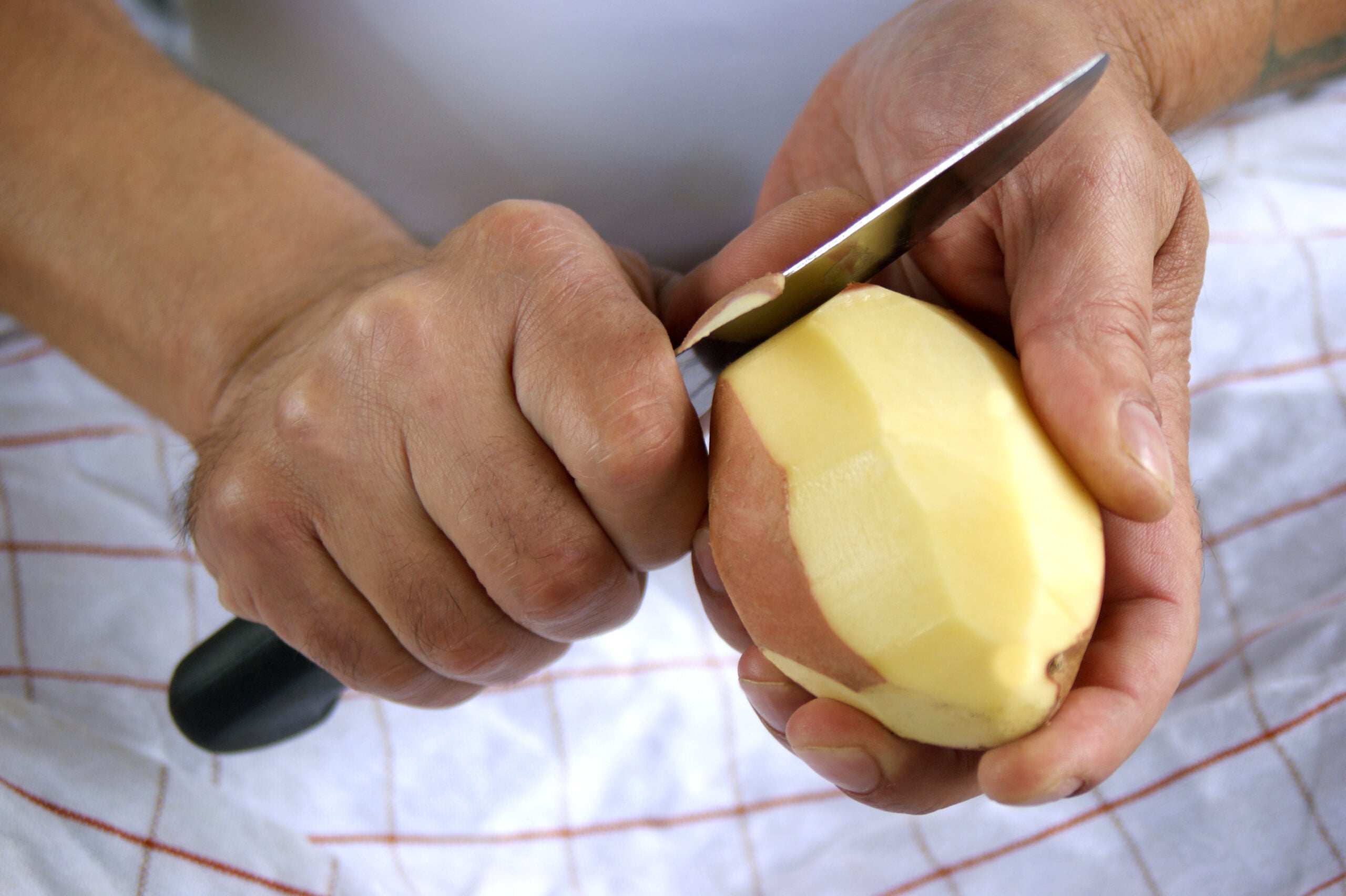
If you choose to follow the less restrictive university-extension guidance for a firm potato with tiny sprouts, inspect and trim the whole potato, not just the most obvious shoot.
- Check the potato’s condition. It should be firm, not wrinkled or collapsing. Set aside any potato with extensive green areas or obvious decay.
- Remove the entire sprout. Cut away the shoot rather than merely snapping off its tip.
- Dig out the eye beneath it. Use a paring knife or the pointed end of a vegetable peeler to remove the base where the shoot emerged.
- Peel and inspect. Remove the peel and any small surface-green areas generously. If green color continues into the flesh, discard the potato.
- Prepare it promptly. Don’t return a trimmed, cut potato to the storage bag and assume it will keep like an intact one.
Do not save the removed sprouts for eating. And don’t turn trimming into an exercise in rescuing every last piece: when the questionable area is extensive, tossing the potato is the better decision.
Why does Poison Control recommend throwing away sprouted potatoes?
The National Capital Poison Center’s Poison Control guidance says people are better off discarding potatoes that have sprouted or turned green. It notes that glycoalkaloid poisoning can cause nausea, vomiting, stomach pain, diarrhea and sometimes neurological symptoms.
Iowa State Extension, by contrast, says potatoes that remain firm and show only small sprouts can be eaten after all sprouts and eyes are removed. Its advice is conditional, and it also calls for discarding shriveled, heavily sprouted or deeply green potatoes. Michigan State University Extension likewise offers conservative advice about avoiding green or sprouted potatoes.
These positions shouldn’t be flattened into a single rule. Removing a sprout lowers exposure, but it does not give a home cook a measurement of what remains inside the tuber. Someone cooking for young children, or anyone who simply wants to minimize uncertainty, has good reason to use the more cautious discard rule.
Is a green potato poisonous, or is the color harmless?
The green pigment is chlorophyll, which is not itself the toxin. Light exposure causes potatoes to produce chlorophyll and can also encourage glycoalkaloid accumulation. In other words, green coloring is a warning sign, not the harmful ingredient.
A small, superficial patch is different from a potato that is green through much of its flesh. Some extension guidance permits generous removal of minor surface greening. When green coloring remains beneath the peeled surface, or covers a substantial area, throw the potato away. You cannot judge its safety from the shade of green alone.
Dark purple or red potato varieties can have naturally colored flesh; that is not the same visual change as a previously pale potato developing a green cast after light exposure.
Will boiling, baking or frying remove the toxins?
No ordinary cooking method should be relied upon to make a badly green or heavily sprouted potato safe. Glycoalkaloids are relatively heat-stable. Research reviewed by Oregon State University Extension shows that preparation methods can change their levels to varying degrees, but cooking is not a substitute for rejecting a questionable potato.
That matters if you’re making mashed potatoes or roasting wedges: a potato doesn’t become suitable just because it spends a long time in boiling water or a hot oven. Don’t use bitter flavor as a tasting test, either. If a cooked potato tastes distinctly bitter or causes a burning sensation in the mouth, stop eating it.
How should you store potatoes to slow sprouting and greening?
Light and warmth are the two problems to tackle first. Store potatoes in a cool, dark, dry, well-ventilated space. Iowa State Extension suggests roughly 45–50°F for longer storage when such a location is available. Most home kitchens are warmer than that, so buying smaller quantities and checking them regularly is often more realistic.
A breathable paper bag, open basket or ventilated box works better than an airtight plastic bag. A countertop bowl may look convienent, but it exposes potatoes to light. A dark pantry or cool basement is a better choice if it stays reasonably dry.
Keep the potatoes away from direct sunlight, heat-producing appliances and onions. Avoid washing them before storage; clean them when you’re ready to cook. Inspect the bag periodically and remove damaged or deteriorating potatoes before they affect the rest.
What if you already ate a green or sprouted potato?
Not everyone who eats a questionable potato becomes ill. Symptoms associated with excess glycoalkaloids can include abdominal pain, vomiting and diarrhea, and more serious poisoning can cause neurological or cardiovascular problems. Symptoms can appear within hours, although they may be delayed.
If you think you may have eaten a toxic potato, contact Poison Control in the United States at 1-800-222-1222 for advice specific to the exposure. Seek urgent medical care for severe symptoms, confusion, trouble breathing or inability to keep fluids down. Do not try to treat a suspected poisoning by eating more food or making yourself vomit.
Are tiny sprouts the same as green flesh?
No. Tiny shoots on an otherwise firm potato and green coloring extending deep into a potato are different warning signs. The former may be handled with careful trimming under some extension recommendations; the latter is a reason to discard the potato. Neither should be mistaken for a promise that a particular potato is toxin-free.
When you have to choose between a questionable old potato and a sound one, use the sound one. The best way to avoid the decision altogether is to buy what you’ll cook soon and keep the rest cool, dark and well ventilated.
Links on this page may be affiliate links, for which the site earns a small commission, but the price for you is the same


Leave a Comment