
Salt is the most widely used flavor enhancer around the world. Salt is salt…right? Well, mostly. All types of culinary salt are mainly sodium chloride, but different types of salt can vary in their sodium content, mineral content, and even color! Enter two types of salt: Celtic sea salt and Himalayan salt.
The main differences between Celtic sea salt and Himalayan salt are:
- Where they originate (sea water vs. specific salt mines in Pakistan)
- Their color
- Sodium content
If you’ve never heard of Celtic or Himalayan salt, don’t worry – we’ll fill you in and reveal the biggest differences below!
What is Celtic sea salt?
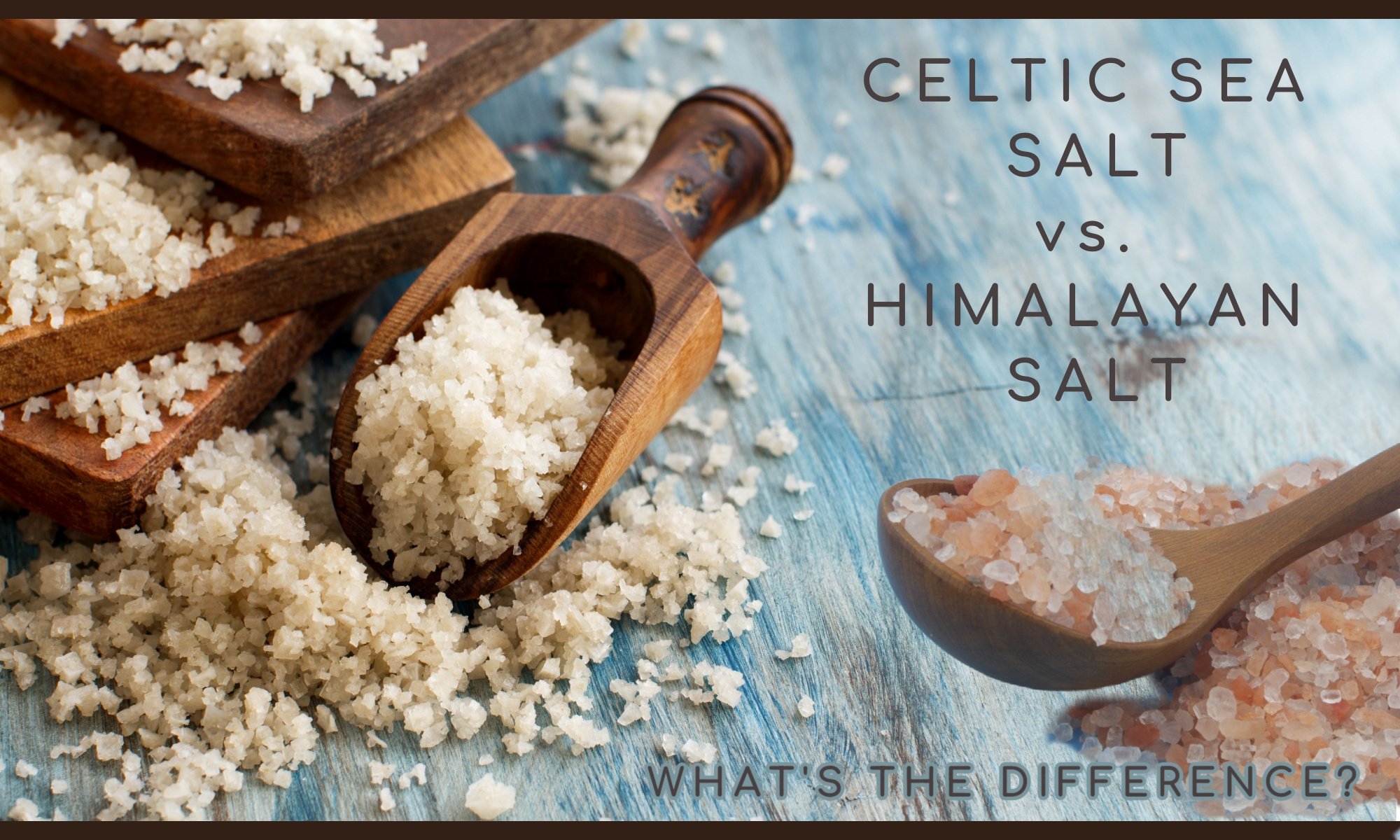
Also called “sel gris”, which is French for “gray salt”, Celtic sea salt has a gray coloring due to its mineral content. Celtic sea salt is made by evaporating seawater near the Celtic Sea off the coast of France, as well as parts of Portugal.
Celtic sea salt is a bit different from sea salt because the salt beds from which it’s harvested have a clay lining, which gives it its subtle gray hue. Like sea salt, Celtic sea salt is less processed than regular table salt and has higher concentrations of minerals like magnesium compared to table salt.
Unlike iodized salt (aka “regular salt”), Celtic sea salt doesn’t have iodine added to it. It’s primarily made of sodium chloride (like all types of salt), but also contains trace minerals. Here is an analysis from Celtic Ocean International for their light gray coarse grind Celtic sea salt:
| Sodium | 31.2% |
| Chloride | 53.7% |
| Calcium | 0.196% |
| Magnesium | 0.3% |
| Potassium | 0.108% |
What is Himalayan salt?
Himalayan, or “pink salt”, has a pink hue and is harvested in Pakistan at the Khewra Salt Mine. Why is it pink, though?! It turns out that the higher concentration of minerals like potassium, calcium, magnesium, and iron gives it its pink hue.
Himalayan salt isn’t the only type of pink salt, but it’s the most popular by far. Other types of salt that are pink besides Himalayan salt include specific types of salt from Hawaii, Peruvian pink salt, and Murray River Salt from Australia.
We couldn’t get our hands on a nifty mineral analysis like Celtic sea salt, but Himalayan salt (and other types of pink salt) does contain other trace minerals like magnesium, potassium, and iron.
What’s the difference between Celtic sea salt vs. Himalayan salt?
Celtic sea salt and Himalayan salt have some similarities, but there are a few differences as well. We’ll compare how they’re different and similar in this handy chart!
| Celtic sea salt | Himalayan salt | |
| Origin | Regions near the Celtic Sea in France and parts of Portugal | Khewra Salt Mine in Pakistan |
| Sea salt? | Yes | No |
| Salt grain size | Coarse or fine grind | Coarse or fine grind |
| Color | Light gray | Pink |
| Sodium content | 1,832 milligrams per teaspoon (fine grind) | 2,120 milligrams per teaspoon (fine grind) |
| Iodine added? | No | No |
As you can see, some of the main differences between Celtic sea salt and Himalayan salt are:
- Their origin (sea vs. salt mines)
- Color (pink vs. gray)
- Sodium content (higher for Himalayan salt vs. Celtic sea salt)
Is Celtic sea salt better for you than Himalayan salt?
If you noticed the difference in sodium between Celtic sea salt vs. Himalayan salt, you might be wondering if Celtic sea salt is better for you. That’s a great question!
Celtic sea salt does have a slight advantage in the sodium content compared to Himalayan salt – we can’t deny that! Celtic sea salt’s slightly lower sodium content doesn’t make it a low-sodium food, so it shouldn’t be thought of as a significantly healthier option compared to Himalayan salt.
The bottom line is that all types of salt (regular salt, sea salt, Himalayan salt, etc.) are high in sodium, a nutrient that should be limited to fewer than 2,300 milligrams per day. (Psst…if you want to add flavor without sodium, consider using herbs and spices!)
What do Celtic salt and Himalayan salt taste like?
The main flavor of salt is, well — salty. (How else would you describe it?!)
You probably wouldn’t be able to tell a huge difference between Celtic sea salt and Himalayan salt with a blind taste test – unless you’re a professional taste tester or chef! However, some critics describe Celtic sea salt as having a “mild” and “briny” taste, and Himalayan salt is sometimes described as being mild in flavor with a more subtle saltiness compared to regular salt.
How do Celtic sea salt and Himalayan salt differ from “regular” salt?
Good ole “regular salt”, or table salt, is the most popular type of salt in most people’s pantries. If a recipe calls for salt, it generally refers to finely ground table salt, which is fortified with iodine, a nutrient important for thyroid health. (Iodine deficiency used to be a problem back in the 1920s, but isn’t as problematic now thanks to the addition of iodized salt in prepared and processed foods.)
Regular salt is mined from underground salt deposits, so it’s not sea salt. Compared to Celtic salt and Himalayan salt, regular salt is a bit higher in sodium (due to its lower content of other minerals) with 2,360 milligrams per teaspoon.
FAQs:
Both Celtic and Himalayan salt boast higher mineral content (like magnesium and calcium) compared to regular table salt, as well as being less refined. Celtic salt is slightly lower in sodium compared to Himalayan salt, so it might be considered better than Himalayan salt by some. (It’s still high in sodium, though, so don’t go overboard!)
You can use Celtic sea salt or Himalayan salt in any way you’d use regular salt. If you use coarser grinds of salt, keep in mind that the amounts used will be different than if a recipe calls for finely-ground salt (which is usually standard).
You can’t fit as many coarse salt granules in a measuring spoon as you will with a fine grind, so you might need to measure the weight for accuracy, or choose finely-ground versions when cooking and baking.





Leave a Comment