
Chickpea flour, also known as garbanzo bean flour, is a staple ingredient in certain cuisines and seemingly ignored in others.
However, while chickpea flour is obviously a great addition to Indian recipes, it also has a lot of fantastic uses as substitute flour in all kinds of different recipes.
How Can I Use My Chickpea Flour?
Chickpea flour can be used as an alternative flour in almost any kind of recipe, but you can also use it as its own ingredient in a variety of unique recipes, like chickpea pancakes or chickpea “tofu.”
Since chickpea is so protein-rich, as well as being a really good emulsifier, you can use chickpea flour to help enrich and thicken pretty anything you want, so long as you are planning on cooking them afterwards!
What Kind Of Special Equipment Do I Need To Make Chickpea Flour?
Just like with making all kinds of different flour substitutes, the only thing you really need to make chickpea flour is a high-powered blender.
However, if you plan on soaking your chickpeas to get a cleaner flavor in your final chickpea flour, then a dehydrator could definitely help speed up the dehydration process.
Other than that, a sieve to help catch any clumpy, unblended bits of chickpea in your flour is an invaluable help to make powdery, fine chickpea flour.
Ingredients
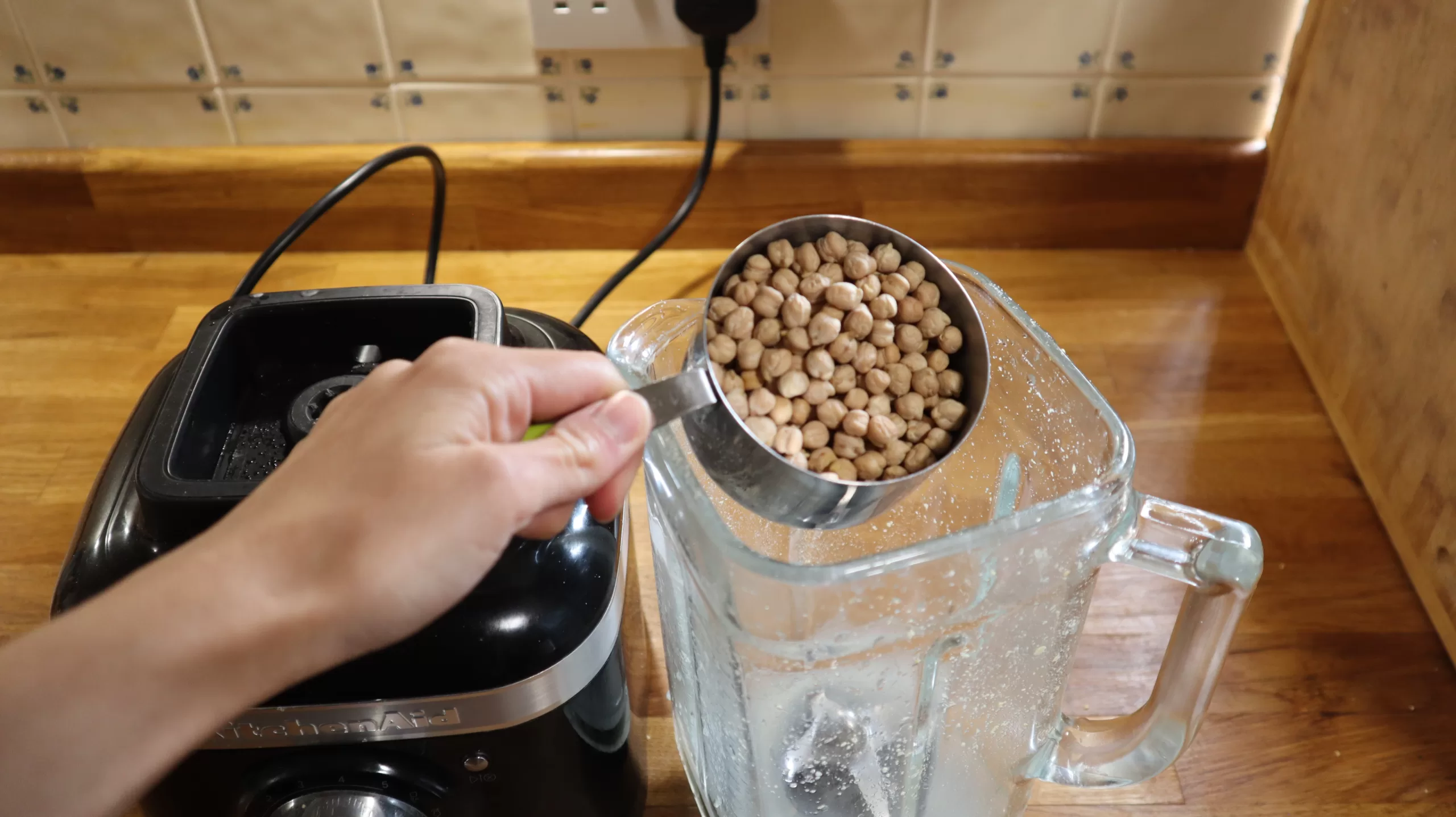
1 cup dried chickpeas

How To Make Homemade Chickpea Flour
Step 1 – For an easy, quick chickpea flour, blend the chickpeas on medium speed until a fine powder.
Step 2 – Pour the chickpea flour through a sieve, pushing aggressively to ensure that no lumps remain, and then store in a lidded container for up to 1 month.
Optionally, for a cleaner, more consistent flavor, however:
Step 3 – Soak your chickpeas in 8 cups of water overnight in a bowl large enough to fit everything in.
Step 4 – After soaking, lay your chickpeas out on a kitchen towel and either air dry them in a sunny spot for 12 hours, or put them in an oven with the fan running for 8 hours to dehydrate them. You can also use a dehydrator to make it even faster.
Step 5 – Once completely dried, pulse your chickpeas in the blender, working your way up to medium speed, before passing it through a fine mesh strainer to catch any remaining lumps.
Step 6 – Store this chickpea flour in the cupboard in a sealed container for up to 1 month.
Watch the Video Version

Troubleshooting Tips
• One thing you might find is that your chickpeas simply refuse to break down properly into a fine flour. If this happens to you, the best thing to do is to blend it on and off, sticking to a lower speed, so as to not heat the chickpeas too much. One of the reasons this might be happening is that some of the natural oils of the chickpeas are starting to leech out due to the chickpeas getting too hot, so blending it at a lower speed will help stop that.
• If there is one thing that chickpeas are well known for, it is their slightly “off” smell when they get broken down. The smell is actually sulphur dioxide, similar to the smell that eggs give off when they start to reach the end of their best before date. If you really want to avoid this, though, soaking the chickpeas will pretty much entirely get rid of it. So as long as you don’t mind the longer prep time needed to soak your chickpeas overnight, it is probably your best bet.
Nutritional Facts
For the health-conscious out there, here are the nutritional details for ¼ cup of chickpea flour.
Calories: 182
Total Fat: 3 grams
Saturated Fat: 0.3 grams
Cholesterol: 0 milligrams
Sodium: 12 milligrams
Total Carbohydrates: 30.3 grams
Dietary Fiber: 8.7 grams
Sugars: 5.4 grams
Protein: 9.7 gram
Potassium: 438 milligrams
FAQs
You can make chickpea flour out of both completely raw chickpeas, and chickpeas that you have first soaked.
The fundamental difference between the two is that soaked chickpea flour will have a lot “cleaner” flavor, because a lot of those really distinctive chickpea flavors will get removed by the soaking.
It ultimately doesn’t matter which one you use, but keep in mind that if you are planning on using chickpea flour to help thicken various recipes, some of the thickening power will get removed in the soaking process as well.
This recipe uses dried chickpeas, primarily because the chickpeas are already completely dry, which makes them super simple to grind into a fine powder.
A lot of people don’t actually have access to dried chickpeas at their local supermarkets, however, instead limiting you to only canned.
If you want to use canned chickpeas instead, just treat them as the soaked chickpeas in this recipe, and you should be just fine. Make sure to completely drain all of the can liquid first, though!
This chickpea flour can be used in basically any recipe you would use other types of flour, including things like bread! Just keep in mind, though, that chickpea doesn’t contain any gluten, which is one of the main factors that gives normal bread its distinctive chew.
While you absolutely can use chickpea flour to make bread, it will end up with more of a flatbread texture and consistency, and not really have any kind of chewiness in it without the gluten.
If you want to keep that same level of breadiness, however, consider just adding some chickpea flour to your bread recipe in place of an equal amount of regular flour, so as to end up with that distinctive chickpea flavor in your bread!

How to Make Your Own Chickpea Flour at Home
Ingredients
1 cup dried chickpeas
Instructions
Step 1 – For an easy, quick chickpea flour, blend the chickpeas on medium speed until a fine powder.
Step 2 – Pour the chickpea flour through a sieve, pushing aggressively to ensure that no lumps remain, and then store in a lidded container for up to 1 month.
Optionally, for a cleaner, more consistent flavor, however:
Step 3 – Soak your chickpeas in 8 cups of water overnight in a bowl large enough to fit everything in.
Step 4 – After soaking, lay your chickpeas out on a kitchen towel and either air dry them in a sunny spot for 12 hours, or put them in an oven with the fan running for 8 hours to dehydrate them. You can also use a dehydrator to make it even faster.
Step 5 – Once completely dried, pulse your chickpeas in the blender, working your way up to medium speed, before passing it through a fine mesh strainer to catch any remaining lumps.
Step 6 – Store this chickpea flour in the cupboard in a sealed container for up to 1 month.
Nutrition Facts
- Serving Size: 1/4 cup


Leave a Comment