
Sugar and mannitol are both sweet-tasting, soluble carbohydrates commonly used in various applications. Sugar, or sucrose, is a combination of glucose and fructose derived from sugar cane or sugar beet. It is widely utilized in food production. On the other hand, mannitol is a type of sugar alcohol that serves as both a low-calorie sweetener and medication. It differs from sugar in its poor absorption in the intestines. Medically, mannitol is a drug used to increase the production of urine, which can help to reduce eye pressure in conditions like glaucoma.
While both substances offer sweetness, their properties and applications set them apart. Let’s have a deep dive into what those properties and applications are.
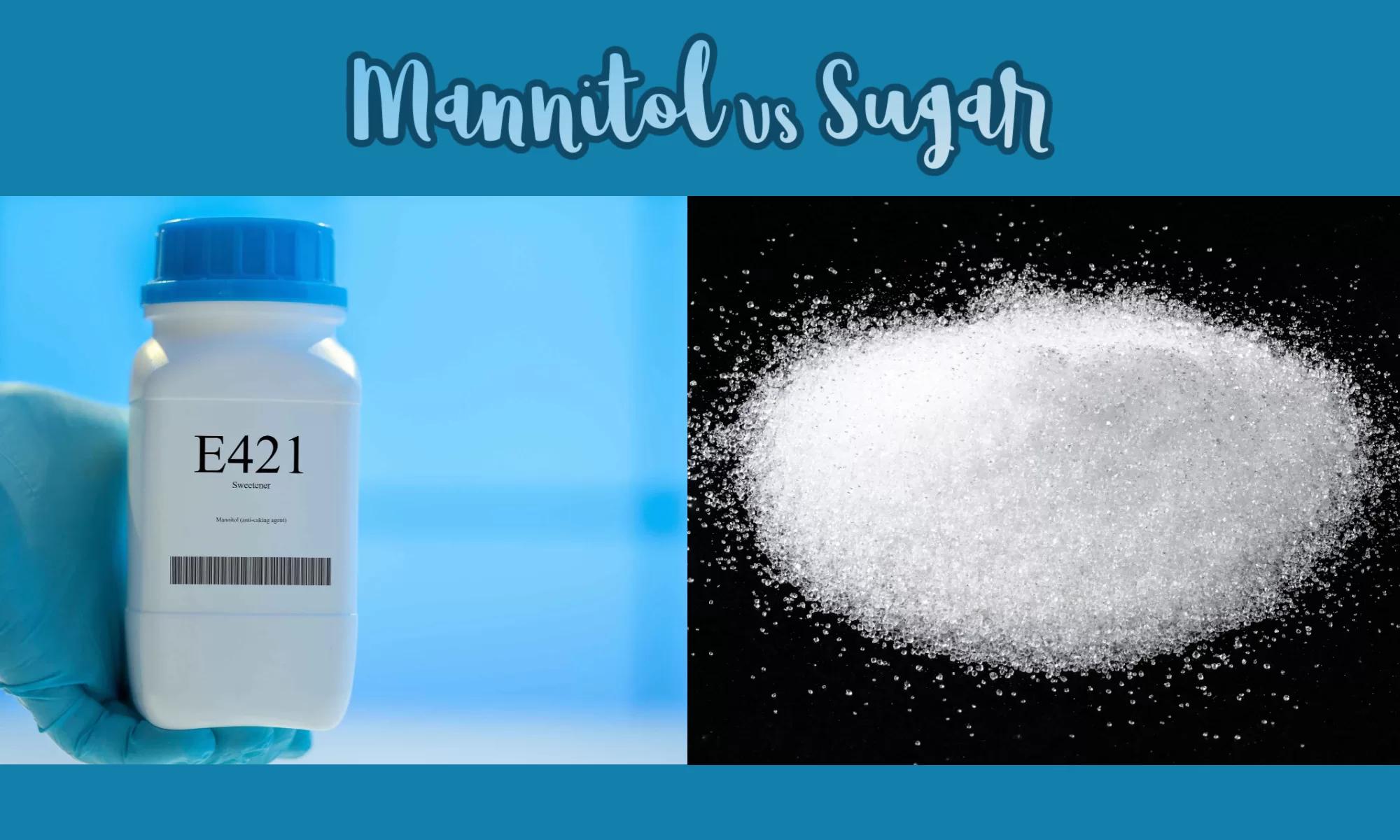
Comparing Mannitol vs Sugar
| Mannitol | Sugar | |
| Substitution ratio | 1-1:5 mannitol: 1 sugar | 1 sugar: 1-1.5 mannitol |
| Gluten-free? | Yes | Yes |
| Keto-friendly? | Yes | No |
| Paleo-friendly? | No | No |
| Common Allergens | Sugar alcohols | Sugarcane |
| Pantry shelf life (unopened/sealed) | 1-1.5 years | 2 plus years |
| Best for baking | Low-calorie and low-sugar treats | Cakes, pastries, muffins, and other sweet baked goods. |
Differences Between Mannitol And Sugar
Simple sugars, known as monosaccharides, include glucose, fructose, and galactose. These sugars naturally occur in various foods, such as fruits and dairy products. Table sugar is a sucrose, which is a combination of glucose and fructose and is typically extracted from sugar cane or sugar beet. It is the main kind of sugar used in baking, as it can help to bulk food, act as a preservative, and modify texture.
Mannitol, on the other hand, is a sugar alcohol or polyol rather than a simple sugar. It occurs naturally in sources like mushrooms, tree bark, and most fruits and veggies. Commercially, mannitol is produced for various food applications such as chocolate coatings, confections, and chewing gum. Compared to sugar, mannitol has about 60 percent fewer calories and is only half as sweet.
Taste and Culinary Uses
Mannitol offers a pleasant, sweet taste that is approximately 60% as sweet as sucrose (sugar). Not only does it provide a satisfying level of sweetness, but it also has the advantage of being lower in calories, containing just 2.6 calories per gram compared to sugar’s four calories per gram. This makes mannitol an excellent substitute for those seeking to reduce their caloric intake.
In terms of taste, mannitol shares similarities with sugar, albeit with a slightly milder sweetness. Its flavor profile is appealing and does not leave a lingering aftertaste. Mannitol is commonly used as a sugar substitute in confectionery and baking, where it not only adds sweetness but also contributes to the overall texture and mouthfeel of the final product. Its ability to mimic the sweetness of sugar while offering fewer calories makes it a preferred ingredient in sugar-free confectionery and energy-reduced products.
Sugar is the gold standard of sweetness when it comes to baking. It is great for providing structure and texture to cakes, cookies, pastries, and other baked goods. It is also inexpensive and readily available.
Are Mannitol and Sugar Substitutes for Each Other?
Try 1.5 cups of mannitol for every cup of sugar to achieve the same level of sweetness in your baked goods. You may need to add a little more liquid to the recipe. Many people are okay with their products being a little less sweet, though, and simply opt for a 1:1 swap.
Nutritional Profile And Health Benefits
- Table sugar (granulated sugar, sucrose) – 2 tsp
- Calories: 30
- Total carbs: 8 g
- Sugars: 8 g
- GI: 65
- Mannitol – 1 tsp
- Calories: 8
- Total carbs: 4 g
- Sugars: 4 g
- GI: 2
Sugar, a simple carbohydrate, offers the body a rapid burst of energy in the form of glucose. Glucose is vital for optimal functioning of the body’s cells, tissues, and organs. On the other hand, mannitol is a diuretic, aiding in the elimination of excess salt and water from the body. This may be helpful for some health conditions, but it is not ideal if you don’t need it.
Diet Suitability
Starting with sugar, it might come as a surprise that it is not considered vegan. Although not directly derived from animals, the refining process often involves bone char, which disqualifies it from being classified as vegan. It is also not keto-friendly, paleo-friendly, or whole30-friendly. Its high glycemic index and level of refinement make it unfavorable for these diets.
Mannitol is somewhat more versatile. Derived from plant starch, mannitol is suitable for both vegans and vegetarians. In terms of keto diets, mannitol, along with xylitol and erythritol, does not contribute to net carbohydrate count. This makes it suitable for individuals following a keto diet who want to manage their carbohydrate intake. However, sorbitol and maltitol, unlike mannitol, should be included in net carbohydrate calculations.
Mannitol’s diet suitability does not extend to the paleo or Whole30 diet, though, where most sugar alcohols are not allowed.
How to Store Mannitol and Sugar
For optimal storage, it is recommended to keep sugar at room temperature in an airtight container. Mannitol should be stored between 68 to 77°F and protected from freezing.
Price and Availability
Sugar can be found for as low as 25 cents per pound, while mannitol prices range from $5 to $20 per pound. Sugar is also much more readily available at most supermarkets.
Environmental Impact
The environmental impact of burning sugarcane is detrimental, mainly due to its contribution to air pollution. When the leafy parts of sugarcane are burned, harmful substances, such as nitrates, carbon compounds, and sulfates, are released into the air, significantly compromising its quality. These substances are directly linked to the ongoing challenge of climate change.
Mannitol is likely less harmful to the environment, as it is produced using a fermentation process and requires fewer inputs such as water and energy.
Mannitol vs. Sugar: The Ultimate Verdict
While mannitol works almost as well as sugar does in baking, I would only use it if baking a treat for my diabetic friends. For those who can consume sugar without any adverse effects, I would opt for regular table sugar. This is because the taste and texture of most baked goods are better when made with natural cane sugar.
FAQ
Mannitol is predominantly eliminated through the intestines and excreted in the feces due to its poor absorption in the small intestine. As a result, mannitol is employed as a sugar substitute in diabetic-friendly food, imparting sweetness without significantly raising blood sugar levels, unlike sucrose.
Mannitol is a medication with diuretic properties. It increases the production of urine and aids in the elimination of excess water and salt from the body. This medication is used to alleviate swelling caused by heart, kidney, and liver conditions and can reduce swelling in the brain and eyes.
Mannitol is categorized as a sugar alcohol rather than a simple sugar, obtained by reducing the sugar mannose. It shares a similar chemical structure with sorbitol, another sugar alcohol compound, rather than sugar, and it is not absorbed well like sugar.




Leave a Comment