
New Jersey has some of the most famous highways in America.
The New Jersey Turnpike. The Garden State Parkway. Interstate 80. Interstate 78. Interstate 287. The Atlantic City Expressway. The roads are crowded, busy, expensive and deeply tied to how people move around the state.
So why doesn’t New Jersey have a Buc-ee’s?
On paper, the state seems like it should be a perfect fit. New Jersey has beach traffic, commuter traffic, long-distance drivers, tourists, truck routes and some of the most heavily traveled roads in the country. A giant Buc-ee’s travel center with barbecue sandwiches, Beaver Nuggets, clean bathrooms and rows of fuel pumps would almost certainly draw attention.
But so far, the famous beaver has not arrived. The closest current Buc-ee’s to New Jersey is the Mount Crawford location in Virginia, off Interstate 81 — a roughly four-to-five-hour drive from much of the state.
New Jersey is not listed on Buc-ee’s official locations map, even as the chain expands into seven new states between 2026 and 2027, including Arizona, Arkansas, Kansas, Louisiana, North Carolina, Ohio and Wisconsin. As we’ve seen with Buc-ee’s expansion plans across the country, the company tends to choose large interstate sites where its enormous travel-center model can work at full scale.
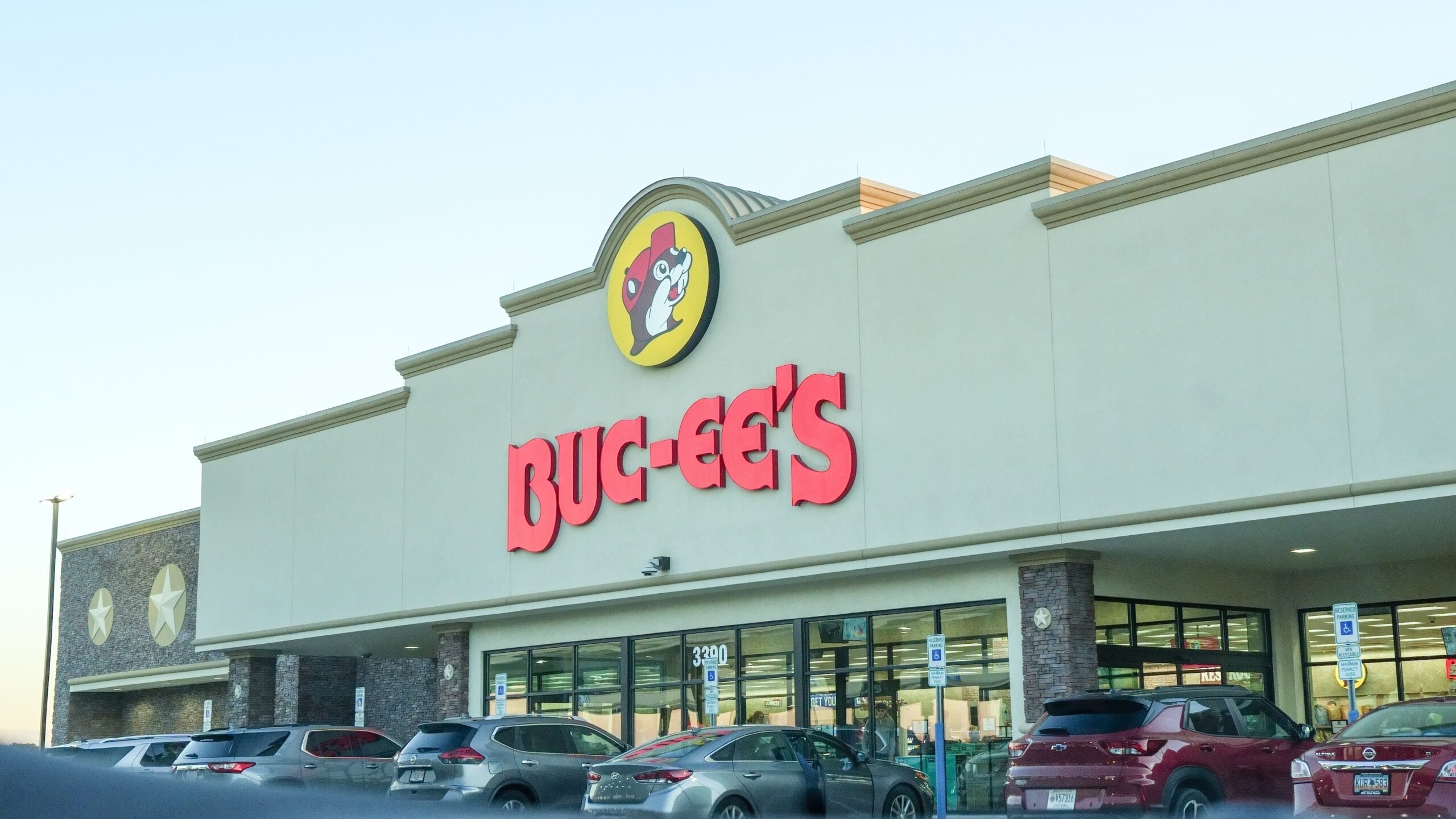
Buc-ee’s has said the quiet part out loud
The most important reason New Jersey doesn’t have a Buc-ee’s isn’t a guess. The company has said it directly.
Jeff Nadalo, Buc-ee’s general counsel and spokesman, told the Asbury Park Press: “The challenge is we can’t open one until the state changes the rules on fueling. We don’t man our pumps.”
That single sentence captures the central issue. New Jersey is the only state in America where drivers still cannot pump their own gas. The state has banned self-serve fueling since 1949 under N.J.S.A. 34:3A-4. Buc-ee’s, meanwhile, is built around high-volume self-service fueling — newer travel centers can have up to 120 fueling positions, with the Luling, Texas flagship measuring 75,593 square feet and the upcoming St. Lucie, Florida location set to span 76,245 square feet.
Staffing every position with an attendant — as New Jersey law would require — would dramatically inflate labor costs and undermine the fast-turnaround model Buc-ee’s depends on. It’s not that the company can’t physically build a store in New Jersey. It’s that the math of running one doesn’t work under the current rules.
The Turnpike billboards are a tease, not a promise
If you’ve driven the New Jersey Turnpike since 2024, you may have seen Buc-ee’s billboards just past Exit 8 in the Sayreville area, showing the red-beaver mascot above the words “Buc-ee’s: 581 miles South.” The signs have stirred plenty of chatter that the chain might finally be heading north.
But the billboards are part of a brand-awareness campaign, not a coming-soon announcement. Buc-ee’s used the same playbook in Florida, running highway billboards for years before the first Daytona Beach location opened. The idea is to introduce Northeasterners to the brand long before any store arrives — so by the time vacationers are driving south through Virginia or Georgia, the name already feels familiar enough to be worth a stop.
That has not stopped New Jersey rumors. A Sayreville Buc-ee’s rumor has been making the rounds for months, and other speculative sites have circulated on social media. But none of them are real projects, and the company’s public position remains that no New Jersey location is planned.
The self-serve gas rule probably isn’t changing soon
The fueling rule is also unlikely to flip overnight, which makes the Buc-ee’s wait longer than just a corporate decision.
State lawmakers have repeatedly introduced bills to allow self-serve gas in New Jersey, with Senator Declan O’Scanlon among the more vocal sponsors. But public opinion has consistently leaned the other way. A Rutgers-Eagleton poll found that 73 percent of New Jerseyans preferred having their gas pumped for them, versus 22 percent who preferred self-serve. As long as that gap holds, the law is unlikely to change — and Buc-ee’s has signaled it will wait for the law to change rather than rework its model.

Density, real estate and existing service areas
Even if the gas rule changed tomorrow, New Jersey would still be a difficult Buc-ee’s market.
Buc-ee’s does not build normal gas stations. Its newer travel centers are massive roadside destinations with huge stores, large fueling areas, big parking lots and enough space to handle crowds. They work best on large parcels just off major highways, where drivers can exit easily, park, shop, fuel up and get back on the road.
New Jersey has the traffic, but it does not always have the kind of land Buc-ee’s wants.
The New Jersey Turnpike and Garden State Parkway already have their own built-in service area systems. Those service plazas offer fuel, food, bathrooms and road-trip stops directly along the highways. That is useful for drivers, but it also means Buc-ee’s would not simply slide into the same model.
Buc-ee’s usually works as a standalone destination near an interstate exit, not as a small service plaza embedded inside a toll-road system. A Buc-ee’s near the Turnpike or Parkway, on the other hand, would require a huge nearby parcel with easy access, traffic improvements and local approvals.
That is not impossible, but it is not simple. The Garden State Parkway in particular runs through dense suburbs, environmentally sensitive areas and communities where a huge new travel center could face intense scrutiny.
In many Buc-ee’s states, the company can find large highway-adjacent sites in fast-growing suburban or exurban areas. New Jersey has some open space, especially in South Jersey, western parts of the state and along certain interstate corridors. But the best highway locations are often expensive, already developed or politically complicated.
A Buc-ee’s needs room not just for the store, but for dozens of fueling positions, parking, delivery access, stormwater systems and traffic flow. Assembling that kind of site near a famous New Jersey highway could be expensive and controversial.
Competition is real, but it might be an opportunity
New Jersey is already convenience-store country. Wawa has a major presence. QuickChek is deeply familiar to many New Jersey drivers. Royal Farms has expanded in the region. Traditional travel centers, rest stops and local gas stations already serve the state’s busy corridors.
Buc-ee’s is different from all of them, but it would still be entering a market where drivers already have strong habits.
That could actually be an opportunity. New Jersey drivers clearly use convenience stores, gas stations and road-trip stops heavily. A Buc-ee’s would probably generate curiosity immediately.
But the company has not needed to rush into one of the country’s most expensive and complicated states when it can keep growing in places with easier land, lower development friction and equally strong highway access.
Where a New Jersey Buc-ee’s could eventually land
If Buc-ee’s ever does come to New Jersey, South Jersey may be the most logical place to watch.
A location near I-295, the New Jersey Turnpike, Route 42, Route 55 or the Atlantic City Expressway could potentially reach shore traffic, Philadelphia-area drivers and long-distance travelers without trying to fit into the densest parts of North Jersey.
Another possibility would be a western New Jersey site near I-78 or I-80, aimed at drivers moving between Pennsylvania, New Jersey and New York.
But for now, those are only possibilities.
New Jersey has the highways. It has the drivers. It has the road-trip culture. It even has the kind of food-and-convenience-store obsession that would make Buc-ee’s feel like a natural conversation starter.
What it does not have is the easy Buc-ee’s formula.
The state is dense, expensive, heavily regulated and already built around its own highway service areas. Add in full-service gas rules, strong public support for keeping them, and fierce convenience-store competition, and New Jersey becomes a much more complicated Buc-ee’s target than it may look from the road.
That is why New Jersey’s famous highways still do not have a Buc-ee’s.
The demand may be there. The traffic is definitely there. Buc-ee’s even has its own lawyer on record explaining what would have to change.
But until the state’s pump rules do change, the New Jersey Turnpike billboards will keep teasing drivers without delivering a Buc-ee’s nearby.
Links on this page may be affiliate links, for which the site earns a small commission, but the price for you is the same


Leave a Comment