
Have you ever tried coconut flour or millet flour? If so, then you know how each offers different textures and flavors for your baking needs. But if you haven’t, you may be unsure which one is best for a new recipe.
Today, we’ve got the inside scoop on both coconut and millet flours – from their unique characteristics and health benefits to comparing how they perform in the kitchen. So put those measuring spoons aside for a sec, and let’s get educated!
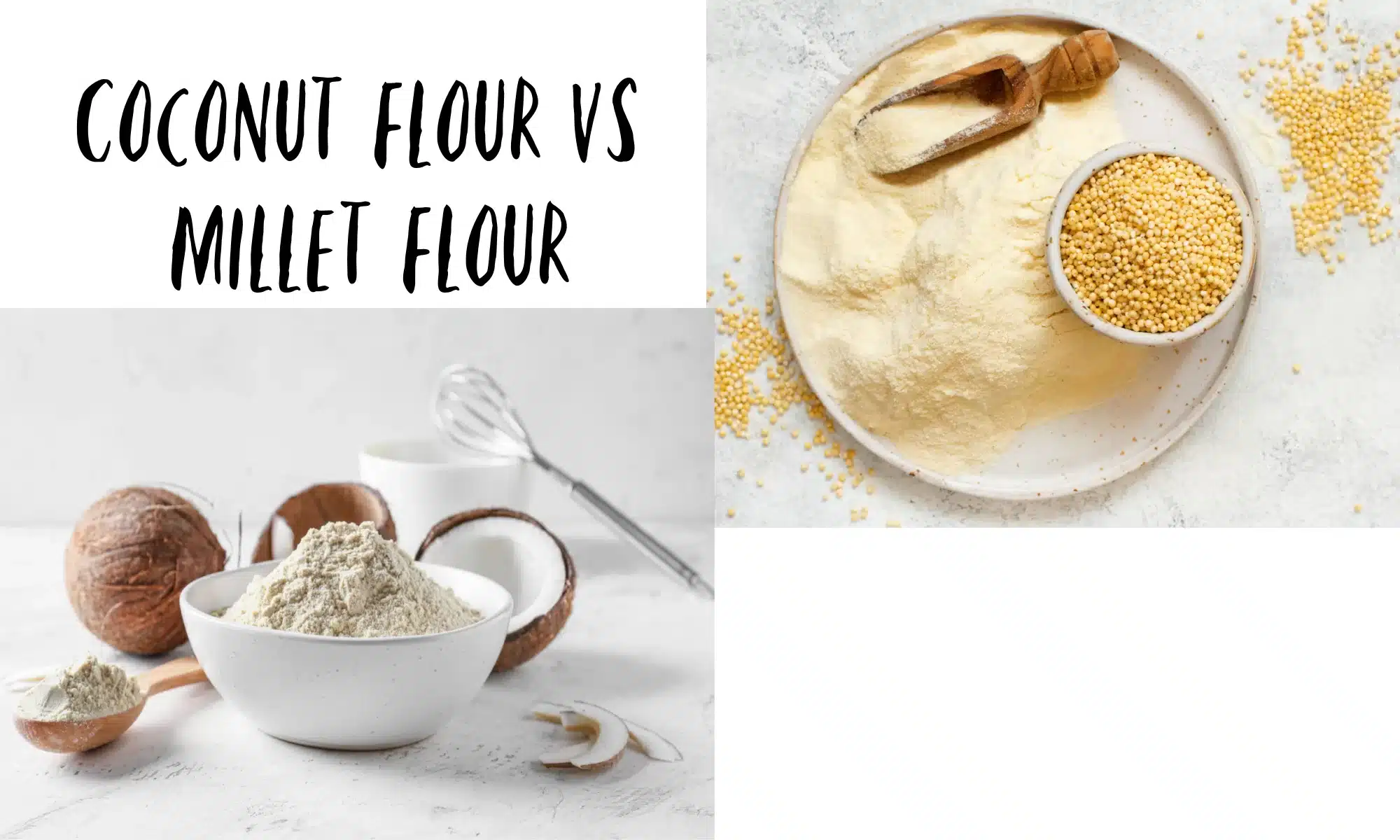
Comparing coconut flour vs millet flour
| Millet Flour | Coconut flour | All-purpose flour | |
| Substitution Ratio | 1:2 | 1:4 | N/A |
| Gluten-free? | Yes | Yes | No |
| Keto-friendly? | No | Somewhat | No |
| Paleo-friendly | No | Yes | No |
| Allergens | Millet, possibly wheat (rare)* | Coconut (tree nuts) | Wheat, gluten |
| Liquid absorbency | High | High | Medium |
| Pantry shelf life (unopened/sealed) | 2 months, or 6 months if frozen. | Up to 2 years | 6-8 months |
| Best for baking | Gluten free cakes, or anything that needs a delicate crumb. | Most desserts – especially cakes, cookies, and pie crusts, muffins. | Non-yeast recipes such as cookies, biscuits, and some breads) |
*Some of the proteins in millet may be similar in chemical structure to those in regular wheat, and it is possible it can trigger reactions in people with a wheat allergy.
Differences between millet flour and coconut flour
If you’re a health-conscious baker, both millet flour and coconut flour have probably made their way into your kitchen at some stage. While both are gluten-free and nutrient-dense, they offer different benefits depending on your baking needs.

Millet is a popular whole grain gluten-free option that produces lighter, more tender baked goods compared to those made with coconut flour. Additionally, coconut flour has a higher fat content than millet flour due to its high levels of healthy fats like lauric acid and medium chain triglycerides (MCTs). This gives it a slightly richer flavor than millet flour and makes it ideal for cookies or bars that require shortening or butter as part of the recipe.
Baking with coconut flour vs millet flour
When baking with either type of flour, keep in mind that coconut flour absorbs liquids more readily than millet flour does. This means that when substituting one for the other in a recipe, you may need to adjust the amount of liquid used accordingly.

Due to its lower fat content, millet flour cannot be substituted directly for coconut flour in recipes that require shortening or butter, and you may need to play with the ratios of fat added to your millet flour recipes. However, it can be successfully used as a substitute in many muffin or quick bread recipes where its fine texture will yield delicious results.
Both flours have a sweetness to them that lends itself well to desserts, but there is a notable difference in the consistency and texture of the baked goods they produce. Millet is better for anything cakey and delicate, and coconut is excellent for denser desserts.
Ingredients in millet flour vs coconut flour
Millet is ground from small, round whole grain hulled millets, usually grown in Asian and African countries, while coconut is derived from dried coconut meat. Neither type contains gluten or nuts, making them suitable for those with allergies or dietary restrictions. Both flours should not contain any filler ingredients. I only ever buy coconut flour made from 100% dried coconut, and here you can see our recommendations for the best coconut flours on the market.
Millet flour + coconut flour nutritional facts
| Per ¼ Cup Serving | Millet flour | Coconut flour | All-purpose flour |
| Calories | 150 | 120 | 110 |
| Carbs | 31g | 18g | 23g |
| Fiber | 1g | 10g | 1g |
| Fat | 2g | 3g | 1g |
| Protein | 4g | 6g | 4g |
| Glycemic index score | 70 | 45 | 85 |
As you can see, millet flour is high in calories and carbs – and not surprisingly, that also leads to a higher glycemic index score (although it’s still less than all-purpose flour). Meanwhile, coconut flour is much higher in fiber and protein than either millet flour or all-purpose flour. That higher fiber content is a key component in coconut flour’s high liquid absorbency and tendency to deliver thicker, denser bakes.
Because of its relatively low carb count, coconut flour has a much lower glycemic index score than millet flour, although it’s still quite a bit higher than, say, almond flour.
Millet flour vs coconut flour storage
Both types of flours should be stored in an airtight container away from heat or moisture. Millet flour can go rancid pretty quickly, so if you are keeping it in the pantry, be sure to use it ASAP, or pop it in the freezer in an airtight container to extend its longevity.
Coconut flour can last quite a bit longer – up to two years unopened, although that’ll depend to some extent on the conditions in your pantry.
Of course, if you want to lengthen storage times for either coconut or millet flour…most flours can be stored in the freezer if you have the space and don’t think you will be able to use it within its suggested use-by date. Just make sure there isn’t any moisture able to get in.
Millet flour vs coconut flour: The ultimate verdict
Ultimately, there is no single “best” type of flour since each one has unique properties that make them better suited for specific recipes over others — just like there is no single “best” type of food! You can check out our deep-dive explainer on all the major different types of flour to help you figure out which one might be a good fit for you.
Coconut flour gets my vote for nutritional superiority for people on weight management or diabetic diets, with a higher fiber content and lower GI.
Both have their own distinct advantages when used correctly in baking projects – so don’t feel like you have settle on just one! Experiment with different recipes until you find which works best for your particular needs, but a good rule of thumb is millet for lighter baked goods and coconut for density.
FAQ
Yes! There are both large and small varieties of millet. Large include pearl,
Foxtail, proso, and finger, and the small millets include kodo, barnyard, browntop, fonio, adlay (or Job’s tears). Pearl is the most widely produced and used.
Millet has a pretty high concentration of antioxidants, which are great for you. It is also a high-calcium grain. It is healthier in that sense than flour, such as all-purpose, but as always, what is considered healthy depends on your specific health needs.
Millet contains compounds deemed goitrogenic, so it isn’t recommended as a primary grain for people with thyroid issues. A little bit is fine, though.



Leave a Comment